Life Lessons From The Grocery Store
I’ve had a couple of surprisingly profound realizations at the grocery store lately.
Apparently the grocery store is where I get my life lessons now.
They happened on different days, in completely different situations, but both started as ordinary moments I probably wouldn’t have thought twice about.
Except I did.
And somewhere between checkout lines, groceries, coupons, and everyday interactions, I noticed a couple of patterns that felt a whole lot bigger than grocery shopping.
The first one started at checkout.
I had brought my reusable bags into the store, loaded up my cart, and made my way to checkout. There wasn't anyone helping the checker bag groceries, and there were people waiting behind me.
So, naturally, I jumped in.
Because that's what I do.
I saw someone who could use some help. I saw a line of people waiting. I didn't want the checker to feel overwhelmed or the people behind me to have to wait longer. Nobody asked me to help. Nobody even suggested that I should.
I just started bagging.
And while I was busy doing that, the checker asked me for the phone number associated with my rewards account.
I gave her the wrong one.
Which meant none of my digital coupons or discounts were applied.
About $100 worth.
😑
I realized what had happened almost immediately, but by then the transaction had already gone through. There wasn't a simple way to fix it. The only option was to cancel the entire order and scan everything again.
My immediate reaction?
Fuck it.
Seriously.
I was embarrassed. There were people waiting. The checker would have to do extra work. It was my mistake. I could feel that familiar urge to just say, "It's fine," swallow the frustration, and leave.
Except it wasn't fine.
We're talking about $100.
And I've been working on something lately: allowing myself to advocate for what I need even when doing so might inconvenience someone else.
So I said, "I'm sorry, but if that's the only way to fix it, then we're going to have to re-scan everything."
And we did.
Standing there, I realized something that went way beyond groceries:
I had gotten so busy doing someone else's job that I stopped paying attention to my own.
My job in that moment wasn't to keep the line moving.
It wasn't to make sure the checker wasn't uncomfortable.
It wasn't to rescue everyone from having to wait an extra few minutes.
My job was to be the customer. Pay attention. Give the correct information. Pay for my groceries.
And because I automatically jumped in to fix a problem nobody had asked me to fix, I created an entirely different problem.
Well, damn.
If that isn't a metaphor for nursing, I don't know what is.
We are really, really good at jumping in
Nurses are problem solvers.
We notice what needs to be done, often before anyone else does.
Someone is struggling? We help.
Something isn't working? We find a workaround.
There's a gap? We fill it.
Someone dropped the ball? We pick it up.
And those qualities can be incredibly valuable.
But sometimes we become so accustomed to anticipating everyone else's needs that we don't stop to ask:
Is this actually mine to fix?
There is a difference between helping someone and automatically taking responsibility for something that belongs to them.
There is also a difference between witnessing someone's discomfort and being responsible for making that discomfort go away.
That's a harder one for me.
Sometimes people are allowed to struggle.
Sometimes systems are allowed to show their cracks.
Sometimes other people need to recognize that they need help and actually ask for it.
And sometimes my job is simply to stay in my own lane and pay attention to what I'm responsible for.
Apparently I needed a grocery checkout line to remind me of that.
Lesson #2: Make forgetting inconvenient
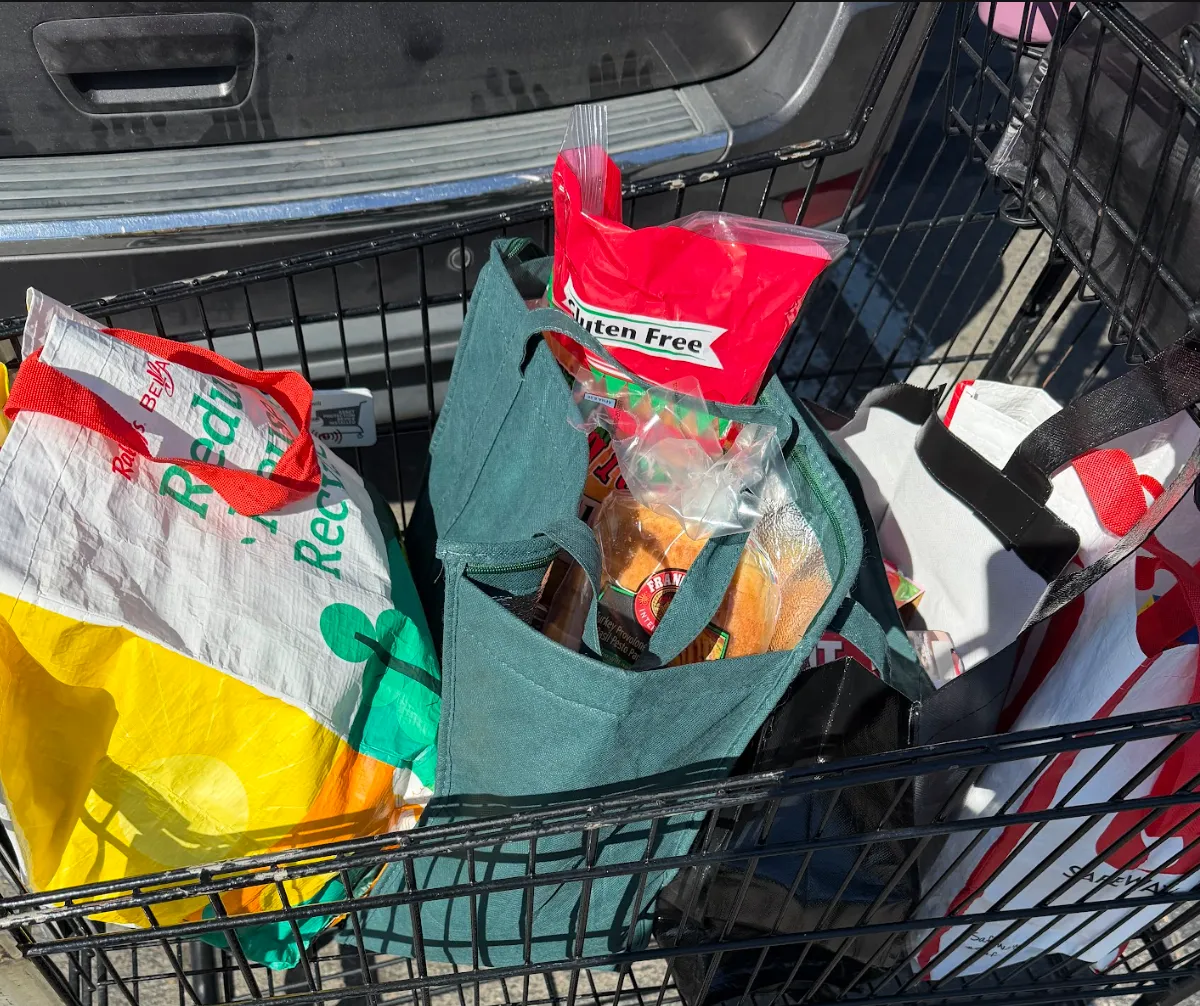
My reusable bags taught me something else, too.
Before COVID, I was pretty good about bringing them to the store. Then reusable bags weren't allowed for a while, and I completely fell out of the habit.
For years afterward, I kept forgetting them.
When plastic bags were readily available, it didn't bother me enough to change. I could reuse those bags around the house, so forgetting my reusable ones wasn't particularly inconvenient.
Then came the paper bags.
Oh, the paper bags.
They're awkward. They're heavy. They rip. They somehow manage to be simultaneously overfilled and impossible to carry.
Every grocery trip ended with me thinking:
WHY DIDN'T I BRING THE DAMN BAGS?
And then I'd forget them again the next time.
Wanting to remember wasn't enough.
Being annoyed wasn't enough.
So I made myself a rule.
If I walked into the store and realized I'd forgotten my reusable bags, I had to walk back out to the car and get them.
If I didn't realize until checkout, I wouldn't take bags at all. Everything went loose into the cart, and I had to bag the groceries myself when I got back to the car.
Was that inconvenient?
Absolutely.
That was the point.
I stopped giving myself the easy way out.
And slowly, I started remembering.
Then I added another step. If I knew I was going grocery shopping that day, I'd put the bags in the passenger seat while I was making my grocery list.
Not hidden in the trunk.
Right next to me.
I made the behavior I wanted easier to remember and the behavior I wanted to stop more inconvenient.
And eventually something that I'd spent years telling myself I "needed to remember" started becoming a habit again.
We do this in nursing, too
How many things do we know would make us feel better, work differently, or take better care of ourselves?
Take the break.
Drink the water.
Pause before automatically saying yes.
Ask for help.
Set the boundary.
Take sixty seconds after a difficult interaction instead of carrying it straight into the next room.
We know.
But knowing something and creating a habit around it are two very different things.
Sometimes we wait until we're motivated enough.
Or until things calm down.
Or until doing it becomes convenient.
Except behavior change usually doesn't happen because we suddenly become better at remembering.
We have to create conditions that support the behavior we're trying to build.
We put the metaphorical reusable bags in the passenger seat.
And when we forget, maybe we allow ourselves to experience a little inconvenience instead of immediately falling back into the easier pattern.
Not as punishment.
As practice.
Again and again and again.
Apparently my groceries had some things to teach me
So that's what I'm taking away from my recent grocery store experiences:
Not every problem I notice is mine to solve.
I can be helpful without automatically becoming responsible.
I can allow someone else to experience discomfort without rushing in to remove it.
I can advocate for myself even when doing so inconveniences someone else.
And if something matters enough that I want it to become a habit, I can't rely on good intentions. I have to intentionally create the conditions that make the new behavior easier to repeat.
None of this is particularly revolutionary.
Maybe that's the point.
Sometimes the things we're working on show up in the most ordinary moments.
In conversations.
In relationships.
At work.
In the grocery store checkout line.
And apparently, sometimes...
in a reusable shopping bag.